Life on the stock exchange – Part 8 | What does it cost to list on the stock exchange?

Summary
- Across 37 Nasdaq Helsinki IPOs, combined costs were 10.1% of capital raised, with individual deals ranging from 5% to 25%. First North costs averaged 8.3%, versus 13.5% on the main list.
- The author argues that high costs and excessive documentation deter listings, and that streamlining the process could support more IPOs and strengthen the capital market.
- Inderes’ 2021 IPO cost EUR 286,903.50, or 5.0% of the 5.7 MEUR raised. The company kept costs down by using challenger advisers, handling the sale itself and limiting documentation.
- The author says IPO costs benefit from economies of scale, while offerings below 12 MEUR have been eligible for a lighter company description on First North since June 2026.
This content is generated by AI. You can give feedback on it in the Inderes forum.
Automatic translation: Originally published in Finnish 01/11/2026, 07:00 GMT. Give feedback here.
The blog series reflects on life on the stock exchange from a company perspective.
"Not everyone in town liked that comment of yours"
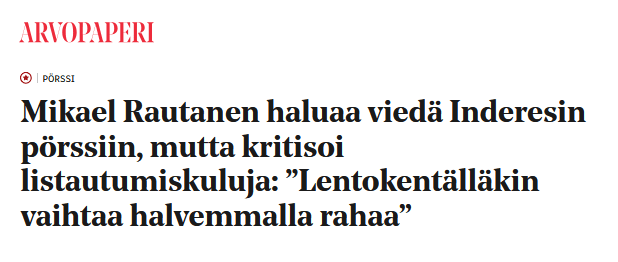
At the end of 2020 – roughly a year before Inderes' own IPO – I gave an interview to Arvopaperi in which I criticized high IPO costs by comparing them to currency exchange at an airport. It ended up in the headline, and I received feedback afterwards. Someone might take offense at this blog post as well.
The problem of listing costs is one that we companies have raised ourselves. In the previous blog, I wrote about Siili Solutions' bold 2012 IPO, which brought First North back to life in Finland. I omitted to mention that Siili's listing costs were 217 TEUR. Nowadays, even in small IPOs, costs below 800 TEUR are becoming a rarity, although the sizes of offerings have grown significantly. Most recently, in the August 2026 issue of Arvopaperi, recently listed companies described how IPO projects feel unnecessarily heavy and require a lot of documentation that is of no benefit to the company whatsoever. Something has gone wrong in the ecosystem. If the barriers related to listing, such as high costs and excessive red tape, could be lowered, there would likely be more IPOs. At least that is what the European Commission believes, having put the rescue of Europe's languishing public capital market on its agenda. For instance, the EU Listing Act, adopted in 2024, aims to make it easier and cheaper for companies to raise capital and list on the stock exchange in the European Union. At the same time, the pie for all advisers would grow, and the competitiveness of the capital market would improve. So far, there has been a lot of talk at the EU level, but relatively little action. Except here in the Nordics, where Finland and Sweden are among the few countries where the number of listed companies has grown over the past decade. And the adviser ecosystem's pie along with it. Not everyone shares the vision of a larger pie achieved by lowering the threshold. One adviser once commented that "in IPOs, the customer's wallet is wide open." The customer rarely knows exactly what they are buying, and the failure of the project is not really an option. Listing costs are reported on the income statement as non-recurring items, and the final bill is settled "off the top of the capital raised." As a result, the cost does not appear directly anywhere, even though it is shareholders' money. An unreasonably large final bill can send a signal to investors about how management and the board handle owners' money. The comment irritated me because it reflects an attitude of milking rather than striving to become better. I do not believe this represents the mainstream of advisers, but when I made the currency exchange comment, it was very much on my mind. What if we tried to make Finland the country with Europe's most efficient listing process? What does an IPO cost in Finland?
We collected data on 37 IPOs on Nasdaq Helsinki between 2020 and H1'26. The data is missing a few companies whose IPO materials had been removed from their investor websites in violation of the regulatory 10-year publication requirement (ADVERTISEMENT: if you buy an IR website solution from Inderes, our team will ensure the regulatory compliance of your site for you). We also excluded technical listings for comparability. In the 37 IPOs included in the data, a total of 993 MEUR was raised, and including share sales, capital totaling 1,963 MEUR changed hands. Companies paid 99.9 MEUR in costs, and selling shareholders paid 38.6 MEUR. The total pie for advisers was therefore 139 MEUR. Combined costs thus amounted to 10.1% of the capital raised, with individual IPOs ranging from 5% to 25%. First North companies pay clearly lower costs relative to capital raised than main list IPOs: 8.3% vs. 13.5%. Based on this limited sample, First North is therefore fulfilling its mission of a more streamlined listing process. In euro terms, the most expensive was Nightingale, which paid 8 MEUR in fees on 110 MEUR of financing raised. The smallest First North listings – Alexandria, Solwers, Witted, and LapWall – kept costs to 0.5–0.6 MEUR in 2021–2022. For these, the capital raised was in the range of 4–8 MEUR. In summary, it is difficult to list on Nasdaq Helsinki with costs of under half a million euros. If you do list, it is advisable to raise 10 MEUR rather than 5 MEUR right away. IPO costs benefit from economies of scale, because a 5 MEUR and a 10 MEUR offering require the same amount of documentation. Since June 2026, offerings of under 12 MEUR no longer require a full prospectus, as companies can list on First North with a lighter company description.
Elsewhere in Europe, the price level is similar
Oxera's study for the European Commission is likely one of the key sources for European comparison. According to the study, total IPO costs are 5–15% of gross proceeds and typically higher in small offerings. The European Commission is concerned about the negative trend. According to market participants, the costs of both listing and being a listed company have risen significantly in recent decades, widening the gap between public and private financing. One reason behind this is Europe's success in what we are known for globally: increasing regulation. In addition, the shrinking of the European capital market – meaning the structural decline in the number of listed companies and the scarcity of IPOs – is accelerating this trend. When the ecosystem shrinks, there are fewer economies of scale and prices are higher.
Finland and Sweden are well placed to show that the spiral can also be made to turn in a positive direction. In the previous IPO cycle, which ended in 2022, we already proved that it is possible. And what about airport currency exchange? The capital raised in Inderes' IPO was partly invested in the company's internationalization, so I regularly pass through Helsinki-Vantaa Airport. While on a business trip, I headed to the Forex counter with my wallet wide open to ask for a quote on exchanging EUR 100 into dollars. The quote was USD 101, which at that day's exchange rate corresponded to a commission of ~12%. Of the sample of 37 companies, 12 paid a higher price than this, so objectively speaking, my comment was slightly exaggerated. However, I consider it a justified counterattack against the wallet story.
Inderes IPO: EUR 286,903.50 and 5.0% of the capital raised
Because I had made a fuss about excessive costs in 2020, we were under pressure to keep our own final bill reasonable in our 2021 IPO. Inderes' final IPO bill came to EUR 286,903.50, and we raised gross proceeds of 5.7 MEUR in the offering. Our original target was to come in below Siili's figure, but that proved too ambitious.
There was no single major breakthrough, but rather several basic things:
- We chose challenger advisers who shared our view on the need for an efficient small-cap IPO. Our goal was to build an efficient team around the project.
- We handled the sale of the offering entirely ourselves, utilizing Inderes' own distribution power. We had no institutional sales at all, which is where an investment bank typically (and deservedly) takes its percentage-based fee.
- We questioned the need for every piece of documentation and comfort letter multiple times. If something was not strictly mandatory, we did not do it.
- We did not produce a traditional marketing brochure; instead, we focused on the investor website and the visual appeal of the prospectus itself.
- (ADVERTISEMENT) We built the investor website on a platform developed by Inderes, which allows the pages to be set up at a fraction of the cost and time
Our costs are not fully comparable because we handled all parts related to investor communications with our own resources. Furthermore, executing a 100% public offering and relying on our own distribution power was a risky choice that ultimately paid off. The market situation and the hype surrounding our company were so intense in 2021 that we anticipated the whole thing would be a walk in the park. Admittedly, we had consciously spent a long time publicly building the foundation for interest in the IPO. Leaving institutions out worked brilliantly for the narrative, as retail investors are usually the ones left out. Had it been executed more conventionally, our price tag would likely have climbed to ~0.5 MEUR.
Previous blogs in the series:
Life on the stock exchange – Part 2 | Does guidance make any sense? Profit warning over 50 TEUR
Life on the stock exchange – Part 3 | I was wrong! Share sales in an IPO are not a sin after all
Life on the stock exchange – Part 5 | Community Adjusted EBITDA
Life on the stock exchange part 6 – Depression took over the small-cap list, but change may be around the corner
Life on the stock exchange – Part 7 | Could the number of companies on the Helsinki stock exchange double?

