A brutal week wiped out the year's returns

Summary
- A sharp weekly sell-off left the S&P 500 up just 0.9% year to date and pushed Helsinki’s main index down 0.4%. The indexes fell 8.6% and 6.6%, respectively, over the week.
- The article links the AI-stock reversal to uncertain investment returns, rising interest rates and concentrated hedge-fund positions. AI infrastructure suppliers have been hit hardest, and the VIX rose to nearly 40.
- US economic data have remained resilient, but the article says the key question is whether market instability will weaken investment, household confidence and earnings growth. Investors are becoming more selective about AI-related stocks.
This content is generated by AI. You can give feedback on it in the Inderes forum.
Automatic translation: Originally published in Finnish 23/11/2026, 05:53 GMT. Give feedback here.
The rough week on Wall Street wiped out the year's returns across many indices. The Helsinki main index is now in the red for the year, and the S&P 500 is only narrowly in positive territory.
| Indexes | Close | 1-week change | YTD | |
| OMX Helsinki | 12372,2 | -6,6 % | -0,4 % | |
| Eurostoxx 600 | 625,7 | -5,8 % | 5,6 % | |
| S&P 500 | 6910,4 | -8,6 % | 0,9 % |
Last week, selling pressure on AI stocks pushed fundamentals aside. The S&P 500 index ultimately fell 3.7% on Friday, and the Nasdaq technology index dropped by over 5%. As recently as just over a month ago, the index was up nearly 20% since the beginning of the year, but this gain has now been wiped out. In addition, the VIX volatility index rose to nearly 40, which indicates that investor fear has clearly intensified.
Behind this is a shift in AI stocks. For three years, nearly all AI-related stocks rose, and investors did not need to separate the wheat from the chaff. Since Nasdaq's peak in early October, this era appears to have come to an end. Risks have emerged from multiple directions. The return on massive investments and off-balance-sheet commitments remains uncertain. Rising interest rates pose a threat to heavily indebted companies. In addition, the Democrats' election victory has called into question the rapid construction of data centers. In the corporate bond market, the prices of hyperscalers' credit default swaps rose to record levels in October.
Hedge funds' heavy concentration in the same stocks has also proven to be a risk, as simultaneous selling amplifies market moves. The hardest hit have been AI infrastructure suppliers, such as chip manufacturers and specialized cloud computing companies. If investment slows, their revenue would react faster than that of large technology companies. Nvidia CEO Jensen Huang's resignation last week wiped 573 BUSD off the company's market value in a week, a record decline for a single company.
Paradoxically, Anthropic's successful IPO also increased selling pressure, as subscribing to it forced investors to sell other holdings. At the same time, the Fed's stance has tightened, and in December the question is no longer whether the policy rate will be raised, but by how much. Government bonds also failed to act as their usual safe haven, and the US 10-year yield fell only modestly to 4.95% on Friday. In addition to inflation concerns, this reflects the large supply of government debt and technology company bonds.
Economic surprise indices
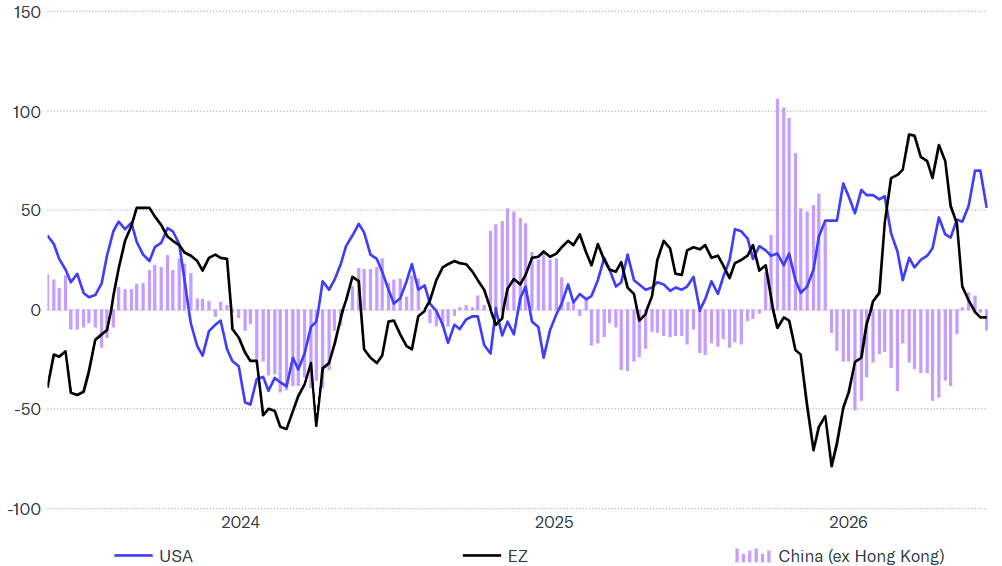
Source: LSEG
It is also odd that the figures for the real economy have held up well so far. US retail sales exceeded expectations, and the number of jobless claims has remained low. Economic surprise indices have turned clearly positive, whereas in the eurozone, surprises have passed their peak momentum. The key question in the coming weeks is whether the instability in the financial markets will begin to be reflected in corporate investments, household confidence, and ultimately earnings growth. AI is unlikely to disappear from investors' agendas, but the trade is becoming clearly more selective.

