Crunchfish keynote on resilient payments at ImagiNxt in Mumbai now available
Crunchfish today announces that the recording of Joachim Samuelsson's keynote presentation at ImagiNxt.com in Mumbai on May 23, 2026 is now available online. In the keynote, titled "Communications Learned to Survive Failure. Payments Never Did.", Joachim Samuelsson discusses why modern payment systems have become critical infrastructure and why continuous system availability can no longer be the only foundation for digital payments.
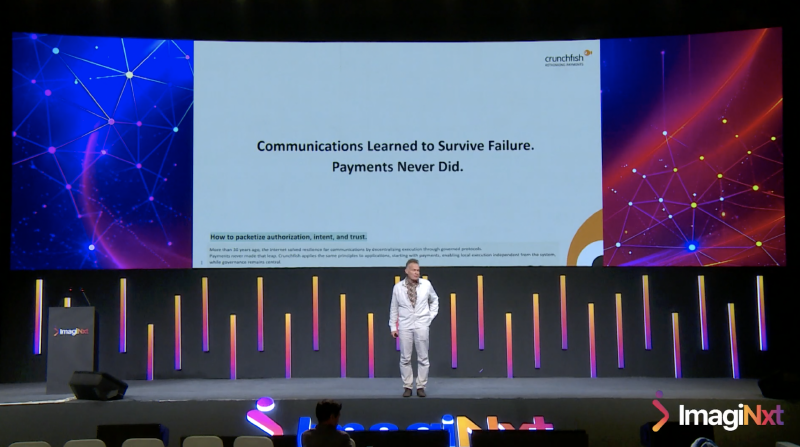
Drawing on the evolution of the internet, the keynote argues that communications became resilient by moving from centralized circuits to packet-switched networks. Payments, by contrast, still largely depend on continuous online authorization, clearing and settlement. When systems fail, payments stop.
Crunchfish's perspective is that the next architectural step is governed execution: a model where user authorization is decoupled from online sessions and represented through a trusted intent. This enables payments to be executed locally, verified later and settled when systems are available again, while governance remains central.
The keynote also covers India's leadership in digital payments, RBI's focus on two-factor authentication and e-cheques, Crunchfish's regulatory approval in the RBI sandbox, and the broader relevance of signed intent for offline payments and emerging agentic AI payment models.
The recording and the transcript are available at this link.
The presentation used during the keynote is attached to this press release and will be available on Crunchfish website.
For more information, please contact:
Joachim Samuelsson, CEO of Crunchfish AB
+46 708 46 47 88
joachim.samuelsson@crunchfish.com
This information was provided by the above for publication on June 18th, 2026, at 15:15 CEST.
Västra Hamnen Corporate Finance AB is the Certified Adviser. Email: ca@vhcorp.se. Telephone +46 40 200 250.
About Crunchfish - crunchfish.com
Crunchfish is a deep fintech company developing governed offline payments technology for payment systems, banks, and payment applications. The company enables offline payments as a Layer-2 solution on top of existing payment systems, allowing transactions to be executed without connectivity while ledger authority and settlement remain unchanged. Through a reservation-based model, resilience is achieved without creating parallel forms of money or unmanaged credit risk. Crunchfish's architecture is patented and enables interoperability across multiple payment systems and markets. The solution strengthens system stability while also supporting economic incentives by ensuring that liquidity backing offline payments remains within the regulated financial system.